Wedding Ceremony Order
Updated
A wedding ceremony order is the list of parts inside the ceremony, from the prelude to the recessional, and who does each one. This page builds one for you and shows a worked example: a traditional ceremony with two readings and four wedding party pairs that starts at 4:00 pm and ends at 4:32 pm, 32 minutes later.
The lengths are typical planning estimates, not rules. Your officiant and your own choices set the real order, so use this as a first draft to talk through with them.
Try it: build your own ceremony order below, or build your full wedding day timeline.
Your ceremony order
32 minutes from the start of the processional at 4:00 pm to the end of the recessional at 4:32 pm. Guests are seated from 3:45 pm.
| Starts | Min | What happens | Who | Notes |
|---|---|---|---|---|
| 3:45 pm | 15 | Prelude and guest seating | guests, ushers | Music plays while guests find seats. Not counted in the ceremony length. |
| 4:00 pm | 4 | Processional | wedding party, couple | 4 wedding party pairs walk in, then the couple. |
| 4:04 pm | 3 | Welcome and opening words | officiant | The officiant welcomes guests and says why everyone is here. |
| 4:07 pm | 3 | Reading 1 | a friend or relative | A poem, a passage or a few personal words. |
| 4:10 pm | 3 | Reading 2 | a friend or relative | A poem, a passage or a few personal words. |
| 4:13 pm | 8 | Officiant's remarks | officiant | Words about the couple or about marriage. |
| 4:21 pm | 4 | Vows | couple, officiant | Written vows read aloud, or the officiant leads and the couple repeats. |
| 4:25 pm | 3 | Ring exchange | couple, best man or maid of honor | The rings are handed over and exchanged. |
| 4:28 pm | 2 | Declaration and first kiss | officiant, couple | The officiant pronounces the couple married. |
| 4:30 pm | 2 | Recessional | couple, wedding party | The couple leads everyone out, then guests are released. |
| 4:32 pm | - | After the ceremony: cocktail hour | guests, couple | Guests move to cocktail hour. See the full-day builder for what happens next. |
Plan the whole day around this ceremony
Print this page with your browser's print command (then Save as PDF if you like): only the ceremony order is printed. The full-day link above carries the start time and the 32-minute length into the day builder.
What each part of the ceremony is, and who does it
Most ceremonies, whatever the tradition, are built from the same handful of parts. Some couples skip a few and some add their own. Here is the common set, with the planning length the builder uses for a traditional ceremony.
- Prelude and guest seating (15 minutes before the start): music plays while ushers or family help guests find seats. It is not counted in the ceremony length.
- Processional (4 minutes with 4 pairs): the wedding party and then the couple walk in. Who walks, and in what order, is the couple's choice.
- Welcome and opening words (3 minutes): the officiant greets guests and says what is about to happen.
- Readings (3 minutes each): a friend or relative reads a poem, a passage or a few personal words. The builder takes 0 to 3.
- Officiant's remarks (8 minutes): words about the couple or about marriage. This is the part that stretches most in a traditional ceremony.
- Vows (4 minutes): written vows read aloud, or vows the officiant leads and the couple repeats.
- Ring exchange (3 minutes): the rings are handed over, often by the best man, maid of honor or a ring bearer, and put on.
- Declaration and first kiss (2 minutes): the officiant pronounces the couple married.
- Recessional (2 minutes): the couple leads everyone back out, and guests are released to cocktail hour.
Two optional parts are available in the builder. A unity ritual (5 minutes) is a symbolic act the couple does together, such as lighting a candle or pouring sand into one vessel. Ring warming (3 minutes) means the rings are passed through the guests, who hold them for a moment and silently wish the couple well, just before the exchange. Neither is required.
Worked example: a 4:00 pm traditional ceremony
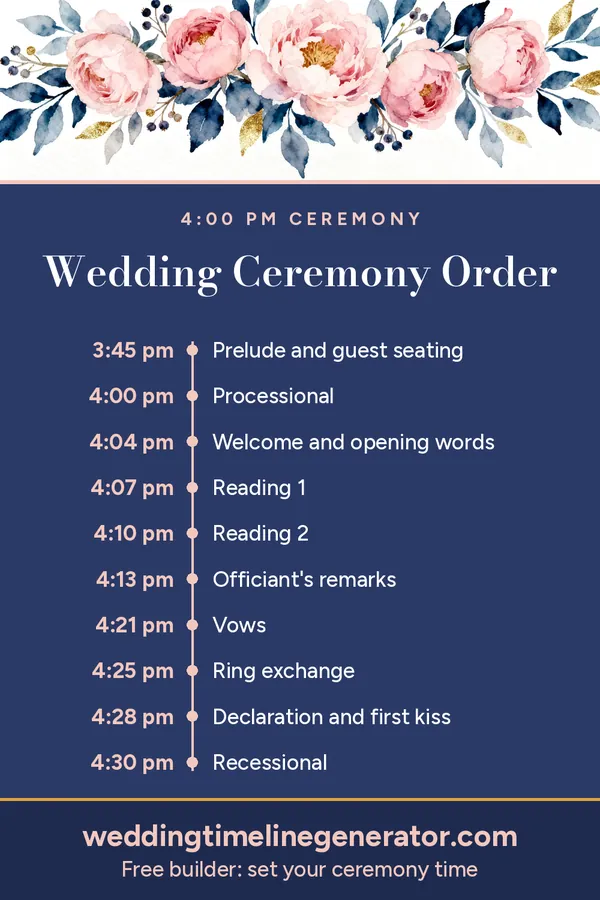
This is the order the builder above produces on first load: traditional style, 2 readings, 4 wedding party pairs, starting at 4:00 pm. Guests are seated from 3:45 pm, the processional starts at 4:00 pm, and the recessional ends at 4:32 pm.
| Starts | Min | What happens | Who | Notes |
|---|---|---|---|---|
| 3:45 pm | 15 | Prelude and guest seating | guests, ushers | Music plays while guests find seats. Not counted in the ceremony length. |
| 4:00 pm | 4 | Processional | wedding party, couple | 4 wedding party pairs walk in, then the couple. |
| 4:04 pm | 3 | Welcome and opening words | officiant | The officiant welcomes guests and says why everyone is here. |
| 4:07 pm | 3 | Reading 1 | a friend or relative | A poem, a passage or a few personal words. |
| 4:10 pm | 3 | Reading 2 | a friend or relative | A poem, a passage or a few personal words. |
| 4:13 pm | 8 | Officiant's remarks | officiant | Words about the couple or about marriage. |
| 4:21 pm | 4 | Vows | couple, officiant | Written vows read aloud, or the officiant leads and the couple repeats. |
| 4:25 pm | 3 | Ring exchange | couple, best man or maid of honor | The rings are handed over and exchanged. |
| 4:28 pm | 2 | Declaration and first kiss | officiant, couple | The officiant pronounces the couple married. |
| 4:30 pm | 2 | Recessional | couple, wedding party | The couple leads everyone out, then guests are released. |
| 4:32 pm | - | After the ceremony: cocktail hour | guests, couple | Guests move to cocktail hour. See the full-day builder for what happens next. |
The ceremony itself is 32 minutes from the first step of the processional to the end of the recessional. The full-day builder allows 30 minutes for the ceremony by default. To plan the day around this ceremony, enter 32 in its Ceremony length box and everything after the ceremony moves for you.
How long each part takes, with the clock from 4:00 pm
The builder gives every part one planning number, but real ceremonies land somewhere inside a range. This table puts our low and high estimate for each part beside the builder's minutes, and it adds the optional license signing, so the clock runs from the 4:00 pm processional to a recessional that ends at 4:37 pm.
| Clock | Part | Typical range | Builder minutes |
|---|---|---|---|
| 4:00 pm | Processional | 2 to 8 min | 4 min |
| 4:04 pm | Welcome and opening words | 1 to 3 min | 3 min |
| 4:07 pm | Reading 1 | 2 to 5 min | 3 min |
| 4:10 pm | Reading 2 | 2 to 5 min | 3 min |
| 4:13 pm | Officiant's remarks | 2 to 10 min | 8 min |
| 4:21 pm | Vows | 2 to 6 min | 4 min |
| 4:25 pm | Ring exchange | 1 to 3 min | 3 min |
| 4:28 pm | Declaration and first kiss | 1 to 2 min | 2 min |
| 4:30 pm | Signing the marriage license | 5 to 10 min | 5 min |
| 4:35 pm | Recessional | 1 to 3 min | 2 min |
Added up, the parts in this order take 19 to 55 minutes, so a 4:00 pm ceremony like this one ends somewhere between 4:19 pm and 4:55 pm. The builder's single estimate is 37 minutes. The officiant's remarks swing the most, from 2 to 10 minutes, so ask your officiant how long they usually speak before you print anything.
When couples sign the marriage license: either during the ceremony, at a small table after the declaration and before the recessional, or right after it, off to one side while guests head to cocktail hour. Allow 5 to 10 minutes for the couple, the officiant and any witnesses your state asks for. Signed during the ceremony, it starts at 4:30 pm here and the total grows from 32 to 37 minutes. Signed afterwards, the ceremony keeps its 32 minutes and the signing uses the first few minutes of cocktail hour instead. Tick the signing box in the builder to put it in your order.
Who has to sign, how many witnesses you need and when the license goes back to the issuing office depend on where you marry, so confirm those details with your officiant or the county clerk.
Prelude and seating: when guests should arrive
The full-day builder asks guests to arrive 30 minutes before the processional, and that whole window is the prelude. Ushers start seating in earnest 15 minutes out, parents and grandparents take their seats in the last 5, and the processional music starts on the minute. With 150 guests or more, open the doors 45 minutes ahead so the line at the entrance has time to clear. For a 4:00 pm ceremony the window goes like this:
- 3:30 pm, doors open: soft instrumental music, someone greeting at the entrance, programs handed out and a sign that points to the guest book.
- 3:45 pm: ushers walk guests to their seats and fill from the front, keeping the first rows free for family.
- 3:55 pm: grandparents and parents are seated, the officiant and whoever waits at the front step into place, and the music quiets.
- 4:00 pm: the musician moves to the processional piece and the first pair begins to walk.
| Processional | Guests arrive from | Ushers seat guests from | Family seated at | 150+ guests: doors open |
|---|---|---|---|---|
| 2:00 pm | 1:30 pm | 1:45 pm | 1:55 pm | 1:15 pm |
| 3:00 pm | 2:30 pm | 2:45 pm | 2:55 pm | 2:15 pm |
| 4:00 pm | 3:30 pm | 3:45 pm | 3:55 pm | 3:15 pm |
| 5:00 pm | 4:30 pm | 4:45 pm | 4:55 pm | 4:15 pm |
A 30-minute prelude is about 9 songs at roughly 3.5 minutes each, and a 45-minute prelude about 13. Hand your musician or DJ a list that long plus one spare, so nothing repeats while the last guests sit down. Put the arrival time on the invitation and the wedding website, and keep the processional time for the cue sheet.
Lining up the walk itself? The processional order builder times every pair
Ceremony order checklist for the day
Go through this list at the rehearsal and once more on the morning of the wedding. The clock times come from the worked example above: a 4:00 pm ceremony with 2 readings and 4 pairs.
- Ring box: the best man or maid of honor carries the rings from the processional at 4:00 pm to the ring exchange at 4:25 pm, out of the box and in a pocket. A ring bearer can carry a pillow with stand-in rings tied on.
- Marriage license and pen: the officiant brings the license, and someone you trust brings two pens. If you sign during the ceremony, set a small table and two chairs to one side before the doors open at 3:30 pm.
- Microphone for the officiant and readers: one for the officiant and one on a stand for the readers, so each 3-minute reading carries to the back row. Test both before the doors open.
- Cue sheet for the musician: prelude from 3:30 pm, processional piece at 4:00 pm, the couple's entrance music at 4:02 pm, and recessional music at 4:30 pm.
- Who holds the bouquet: the maid of honor takes it when the couple reaches the front at 4:04 pm, keeps it through the vows and rings, and hands it back after the kiss, before the recessional at 4:30 pm.
Four mistakes that throw the order off, and the fix for each:
| Mistake | What goes wrong | Fix |
|---|---|---|
| Printing the processional time as the arrival time | Guests are still parking at 4:00 pm and walk in behind the wedding party. | Print 3:30 pm, 30 minutes earlier, and keep 4:00 pm for the music. |
| Leaving the license signing out of the order | The ceremony runs 5 to 10 minutes past its planned end, into cocktail hour. | Add the signing in the builder: the example becomes 37 minutes and ends at 4:37 pm. |
| One short song for a long processional | With 8 pairs the walk takes 6 minutes, so a 3.5-minute song ends before the couple enters. | Plan 2 pieces or one that can repeat, with a separate piece for the couple. |
| Readers with no microphone and no printed copy | A 3-minute reading stalls while a phone is unlocked, or the back rows hear nothing. | Print each reading in large type, give the officiant a spare copy and seat readers on the aisle near the mic. |
Processional order: who walks when
There is no single correct processional. It varies by tradition, by venue and above all by what the couple wants, and some couples walk in together or have no wedding party at all. A very common arrangement, and the one the builder's timing assumes, goes like this:
- The officiant takes their place at the front, and whoever runs the music starts the processional piece.
- Grandparents and parents of the couple are seated, in the order your families prefer.
- The wedding party walks in as pairs or one at a time, usually with the people who stand nearest the couple walking last.
- The maid or matron of honor, then the best man if he is not already at the front, then any ring bearer and flower girl.
- The couple enters last, sometimes each escorted by a parent or both parents, sometimes together.
The builder counts 2 minutes for the couple's own entrance and 0.5 of a minute for each pair, rounded up to a whole minute. That is our planning assumption for a steady walk down an aisle of typical length, so a very long aisle or slow music will take longer. With no wedding party the processional is 2 minutes; with the maximum of 8 pairs it is 6 minutes. The recessional is shorter because everyone leaves together: 1 minute with no party and 3 minutes with 8 pairs.
In the traditional example, changing only the number of pairs moves the whole ceremony from 29 minutes (no wedding party) to 35 minutes (8 pairs).
Civil, traditional and short ceremonies compared
The four styles in the builder are a short civil ceremony, a traditional ceremony with readings, a short 15-minute version and a ceremony with a unity ritual. Each style uses its own default number of readings and wedding party pairs, shown in the table, and you can change both.
| Style | Readings | Wedding party pairs | Unity ritual | Ceremony length | Recessional ends |
|---|---|---|---|---|---|
| Civil (short, non-religious) | 0 | 3 | no | 17 min | 4:17 pm |
| Traditional (with readings) | 2 | 4 | no | 32 min | 4:32 pm |
| Short (about 15 minutes) | 0 | 2 | no | 15 min | 4:15 pm |
| With a unity ritual | 1 | 4 | yes | 27 min | 4:27 pm |
At these defaults a civil ceremony takes 17 minutes, a traditional one 32 and one with a unity ritual and one reading 27 minutes. The difference is mostly the officiant's remarks and the readings, not the vows: traditional remarks are 8 minutes in the builder against 3 for civil. The short style keeps every part but trims each one, and with 2 pairs it comes to exactly 15 minutes. Adding a unity ritual and ring warming to the traditional example makes it 40 minutes.
Catholic wedding ceremony timeline: the order with and without a Mass
How to use the ceremony order builder
Pick a style, set the start time when the processional music begins, then enter how many readings and how many wedding party pairs you expect and build the order. Tick the unity ritual or ring warming if you want them. The table recalculates every start time, and the ceremony length at the top is the number to enter in the full-day builder. Use your browser's print command to print just the order: the form and the rest of the page are hidden when you print. Share the printed order with your officiant, your DJ or musicians and the person who will line up the wedding party.
Wedding ceremony script: the words, with minutes for each part
Plan the whole day around this ceremony
Your ceremony order is 32 minutes long. The full-day builder works backwards from the ceremony for hair and makeup, photos and travel, and forwards for cocktail hour and the reception. Open the wedding timeline builder with this ceremony, or start from a preset such as first look or two venues.
Prefer paper? Open the blank day timeline template.
Want this plan in your inbox? Email me this timeline from the full-day builder: you get a link to open on your phone or forward to your photographer.
Frequently asked questions
How long is a wedding ceremony?
With the builder's planning defaults a civil ceremony is about 17 minutes, a traditional one with two readings is about 32 and a short one about 15. Real ceremonies vary with the officiant, the readings, the size of the wedding party and any ritual, so ask your officiant for their usual length.
What is the order of events in a wedding ceremony?
A common order is the processional, the welcome from the officiant, any readings, the officiant's remarks, the vows, the ring exchange, an optional unity ritual, the declaration and kiss, and the recessional. The builder above gives each part a start time, and you can drop or move the optional ones.
Who walks down the aisle first?
It depends on tradition and on the couple. In a common arrangement the officiant is already at the front, then family is seated, then the wedding party walks in, and the couple enters last. Many couples change this, for example by walking in together, so decide it with your officiant and your families.
When do the readings happen?
The builder puts them after the welcome and before the officiant's remarks, at 3 minutes each. Many couples place them there, but some put one after the vows or after the rings. Moving a reading changes nothing about the total length.
Can the order of the ceremony change?
Yes. The order on this page is a common one, not a rule. The vows, the rings and the declaration usually stay in that sequence, while readings, a unity ritual and ring warming can move or be left out. Your officiant may also have requirements for your venue or your tradition, and the legal parts of a ceremony depend on where you marry, so check with them.
Does a short ceremony feel rushed?
It can be plenty if you keep what matters to you. The short style here is 15 minutes with 2 wedding party pairs and still has the welcome, vows, rings, declaration and a processional and recessional. If it feels tight on paper, add one reading or lengthen the remarks and watch the total grow minute by minute.
What time should the ceremony start if guests are arriving?
The start time in the builder is when the processional music begins, not when guests are asked to arrive. Plan for guests to be seated before that moment, and tell them an earlier arrival time on the invitation or wedding website. How much earlier depends on your venue and guest count, so ask your venue and officiant; then enter the processional time here and read the rest of the ceremony off the table.
Where do the ring bearer and flower girl go in the ceremony order?
They usually walk right before the couple, after the wedding party, and often sit with family once they reach the front. Young children can change their minds at the last minute, so many couples ask a parent to wait with them at the aisle and plan a calm backup, such as walking with an adult. Tell your officiant either way.
When do the officiant and the partner at the altar take their places?
The officiant usually stands at the front before the processional music starts, and the partner waiting at the altar takes their spot with the wedding party's groomsmen or attendants. Agree on this at the rehearsal so everyone knows where to stand, and so the first walk down the aisle starts right on the music cue.
Does the ceremony order change if an outdoor ceremony moves indoors for rain?
The order stays the same, but the timing around it changes. Agree a call time with your venue, such as the morning of the wedding, decide who flips the space, and add that setup time before guests are seated. A narrower aisle can mean the wedding party walks in fewer pairs. The wedding rain plan page shows a dry-day and a rain-day timeline side by side.
What is the order of a wedding ceremony?
A common order is the processional, the welcome, any readings, the vows, the exchange of rings, the declaration and kiss, and the recessional. A unity ritual or a short address from the officiant can sit before the vows. Use the table above for times, then ask your officiant to confirm the order for your venue and tradition.
What is the difference between the wedding ceremony order and the wedding order of events?
The ceremony order covers only the ceremony itself, from the processional to the recessional. The order of events covers the whole day: getting ready, the ceremony, cocktail hour, and the reception moments such as the grand entrance, toasts, first dance, cake cutting and send-off. Plan the ceremony order first, because its length sets the start of everything after it.
Do the parents walk down the aisle in a wedding ceremony?
Often, yes, but it is a choice. In many ceremonies grandparents and parents are seated or escorted in just before the wedding party, and some couples are walked in by one or both parents. Others have everyone seated first and start the processional with the wedding party. Settle it with your officiant and add a minute or two to the processional if parents walk in.
Should we add a unity ritual to the ceremony order?
It is optional. A unity candle, sand or hand-fasting adds a few minutes between the ring exchange and the declaration, so build it into the order if you want one and tell your officiant. Skip it and the ceremony stays shorter, and nothing else in the day moves.
Do the vows or the ring exchange come first?
In the most common order the vows come first and the ring exchange follows, because the rings are given as a sign of the promises just made. Some couples say the vows while exchanging the rings, and many ceremonies change this to suit their tradition, so confirm it with your officiant and mark it in the order above.